The Ivory Tiles 牙牌神數
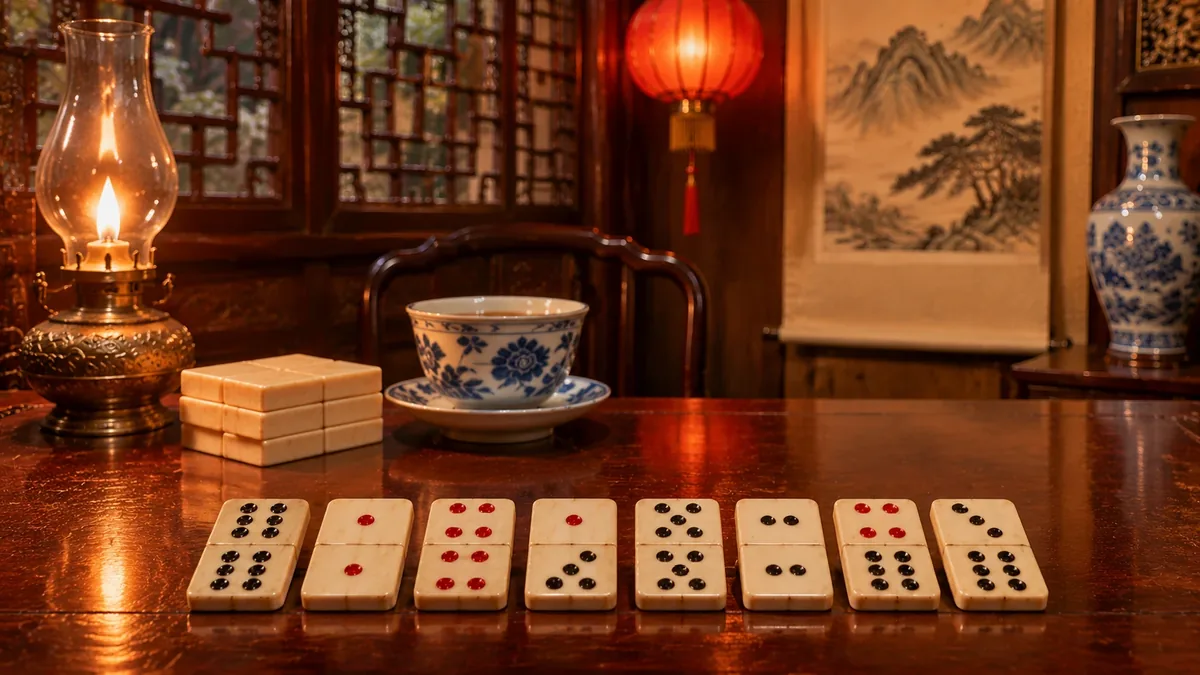
Long before mahjong, the Chinese played with 32 dominoes, often made of ivory or bone. In the Qing dynasty a little book showed how to use them to tell fortunes, alone at a table: lay out the whole set in one row, take away the lucky groups of tiles, and count what they are worth. Do it three times, and the three results point to one of 125 answers. Books of the ivory-tile numbers were still being printed in Canton in the 1860s and sold to working people across southern China.
全副牙牌一字排,中間看有幾多開。
連排三次分明記,上下中平內取裁。
“Lay the whole set out in a row, and see how many scores it holds. Deal three times and mark each well; high, low or middle, judge from there.” An old rhyme that sums up the method.
How to consult
- Think of one clear question. Type it in if you like; it stays on your device.
- Tap Deal the tiles. The 32 tiles are shuffled face down, laid out in one row and turned over.
- The app looks along the row for groups of three neighbouring tiles that make a scoring pattern, or two identical tiles side by side. Each group it finds lights up, scores, and is taken away, and the row closes up. When nothing more can be taken, the scores are added up and graded.
- This happens three times: for the beginning, the middle and the end of your matter. The three grades give one of 125 answers, with a story from Chinese history or legend and a reading for your question.
Your question and answers stay on this device.
Your past answers
How do we know?
- ✔ A real book. Fortune-telling with the ivory tiles was popular in the Qing dynasty; one version is 《牙牌靈數》 by 岳慶山樵. The American museum curator Stewart Culin owned a copy printed in Canton in 1865, and wrote that Chinese workers who came to America knew the method well.
- ✔ The 32 tiles. A Chinese domino set has eleven tiles that come in pairs (like double six and double one) and ten single tiles, 32 in all. On traditional sets the ones and fours are red.
- ✔ The method. Shuffle face down, lay the tiles in a row, turn them over, find the scoring groups of neighbouring tiles, add the scores, and grade the total; repeat three times. Culin describes this, and Chinese sources give the same nine scoring groups: 不同 (six), 五子 (five), 合巧 (four), 分相, 馬軍, 么二三, 二三靠 and 對子 (three each), and 正快 (one).
- ✔ The grades. 12 or more is 上上, 10–11 上中, 8–9 中平, 5–7 中下 and 1–4 下下; with no score at all, you pray and deal again. Five grades taken three times give 125 answers, which is how many the book has. (Culin's edition counted 10–11 as the top grade, so editions differed a little.)
- ≈ The order of the search. The books do not say in what order to look for groups. The app starts at the left, takes the best group it finds there, closes the row and starts again from the left.
- ≈ Beginning, middle and end. Reading the three deals as the beginning, middle and end of your matter is our way of explaining the answer.
- ≈ The verses. Each of the book's 125 answers is a short verse about a famous person or story, with a few words of explanation. We could not obtain the original text, so the 125 readings here are our own, each built, in the book's manner, around a well-known story.
Method: S. Culin, Chinese Games with Dice and Dominoes, Report of the U.S. National Museum for 1893 (Washington, 1895), pp. 517–518 (public domain); Chinese Wikipedia, 牙牌靈數, after 清·岳慶山樵《牙牌靈數》. Readings: our own.
The tiles wait for your question.