The SikidySeed divination of Madagascar
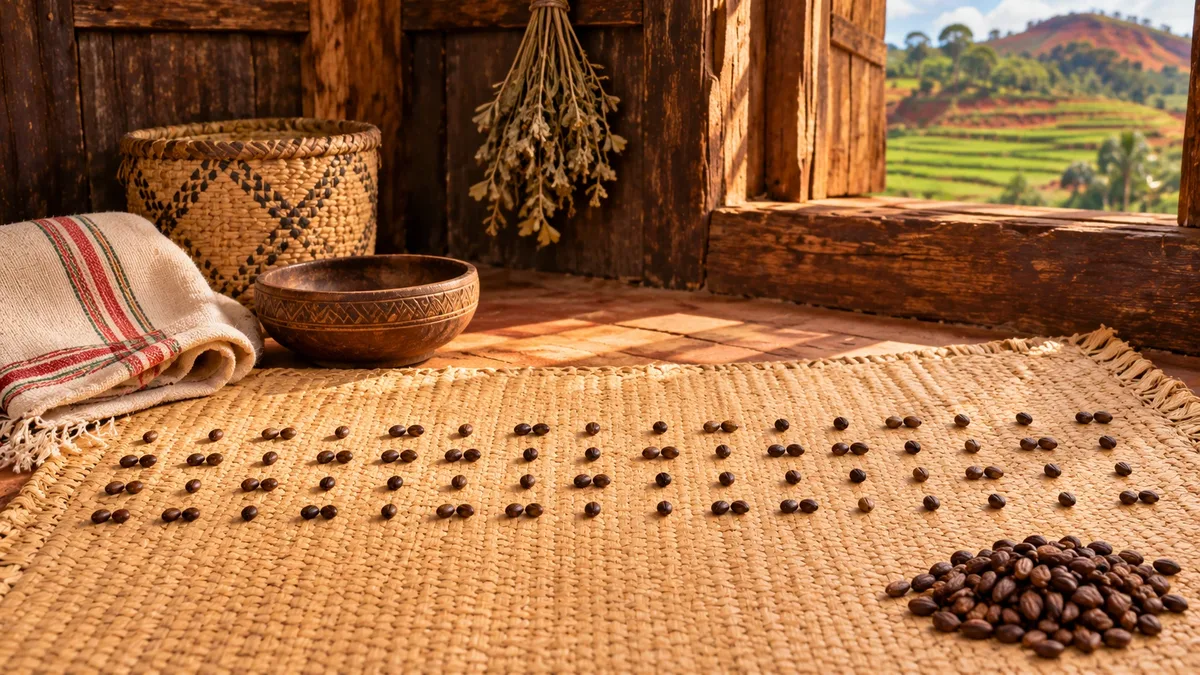
All over Madagascar, a diviner called the mpisikidy would spread a mat, pour out a heap of seeds of the fano tree, and call on God to wake the sun, the sun to wake the cock, and the cock to wake mankind, so that the sikidy would wake and tell the truth. Then he took up handfuls of seeds and counted them off in twos, laying out columns of one seed or two, until sixteen columns covered the mat. Each column has a name, like Wealth, Woman, Enemy, Road, House or God, and the answer lies in where the same pattern of seeds appears again.
The art came to Madagascar centuries ago with Arab traders: it is a form of the "science of the sand". The Norwegian missionary Lars Dahle spent many hours with a diviner in the 1880s and wrote the whole method down, with the words of the invocation, which we follow here.
The awakening of the sikidy
"Awake, O God, to awaken the sun! Awake, O sun, to awaken the cock! Awake, O cock, to awaken mankind! Awake, O mankind, to awaken the sikidy — not to tell lies, not to deceive, not to play tricks, not to talk nonsense; but to search into the secret, to look into what is beyond the hills and on the other side of the forest, to see what no human eye can see."
As taken down by Lars Dahle from a diviner in Imerina, 1880s.
How to consult
- Think of your question, and choose what it is about: a person or anything at all (Tale), wealth and property, family, or your town or community.
- Tap Raise the sikidy. Four handfuls of seeds are counted off in twos to make the four "mothers", and the other columns are raised from them.
- If a "slave" figure falls in the column of God, the sikidy is broken up and raised again, as the diviners did.
- Your answer is read from the columns where your question's figure appears again.
The sixteen figures
Each column holds one figure of four rows, one seed or two in each. The eight "nobles" (gold border) may stand in the column of God; the eight "slaves" may not.
Your question and answers stay on this device.
Your past sikidy
How do we know?
- ✔ An old art. Étienne de Flacourt, the French governor at Fort Dauphin, listed the sixteen figures of the sikidy in 1658 and noted that the diviners had their learning from the Arabs. Many of the figure names are Arabic names of the signs of the zodiac.
- ✔ The same figures as Europe's. Flacourt gave each figure its European geomantic name and wrote that they "have the same meaning and power" as in Europe. Their patterns of one and two seeds match the European figures exactly, so the page also gives each figure's traditional European meaning, in our words.
- ✔ Dahle's account. Lars Dahle published "Sikidy and Vintana: half-hours with Malagasy diviners" in the Antananarivo Annual in the 1880s, from long sessions with a diviner, and James Sibree summarised it in 1896. The invocation, the figures and their names, the names of the columns, the rules for raising the sikidy, the test of God's column and the special meanings all come from them.
- ✔ Raising the sikidy. The first four columns are made from handfuls of seeds counted off in twos. The next four are the rows of those four, read across. The last eight are each made from two earlier columns: where the seeds of a row add up to an odd number, one seed is laid; where they add up to an even number, two.
- ✔ Nobles and slaves. Only eight figures "agree with God". If a slave figure falls in the column of God, "the sikidy has not done proper honour to God", and the diviner broke it up and began again.
- ✔ Reading it. Dahle's diviner chose one of the first four columns to stand for the question, then looked for the same figure in the other columns. Dahle's example: asking about a ship, the same figure in Road means it is on the way; in Enemy, beware of pirates; in Food, there is no lack of food on board. Dahle also lists special pairs of columns and what a lone figure in God's column means, with the offerings (faditra) to be thrown away.
- ≈ Our readings. Dahle does not give a fixed answer for every column. For the columns where he gives none, the reading on this page is our own, built from his examples and the meaning of the column's name.
- ≈ Left out. Real diviners went much further, with sixteen more side columns, combined figures and many charms. We give the core of the art.
- ✔ A living tradition. Sikidy is still practised in Madagascar today by diviners and healers called ombiasy. This page shows the old method as Dahle recorded it; it is not a real consultation.
Sources: L. Dahle, "Sikidy and Vintana: half-hours with Malagasy diviners", The Antananarivo Annual and Madagascar Magazine (1886–88); J. Sibree, Madagascar before the Conquest (London, 1896), ch. XIII; É. de Flacourt, Histoire de la grande isle Madagascar (1658). All public domain, from the Internet Archive. Readings: our own. Mat picture: made for this app.
The sikidy is asleep.