Samuel's Sixteen FiguresAn oracle from the letters of the Psalter
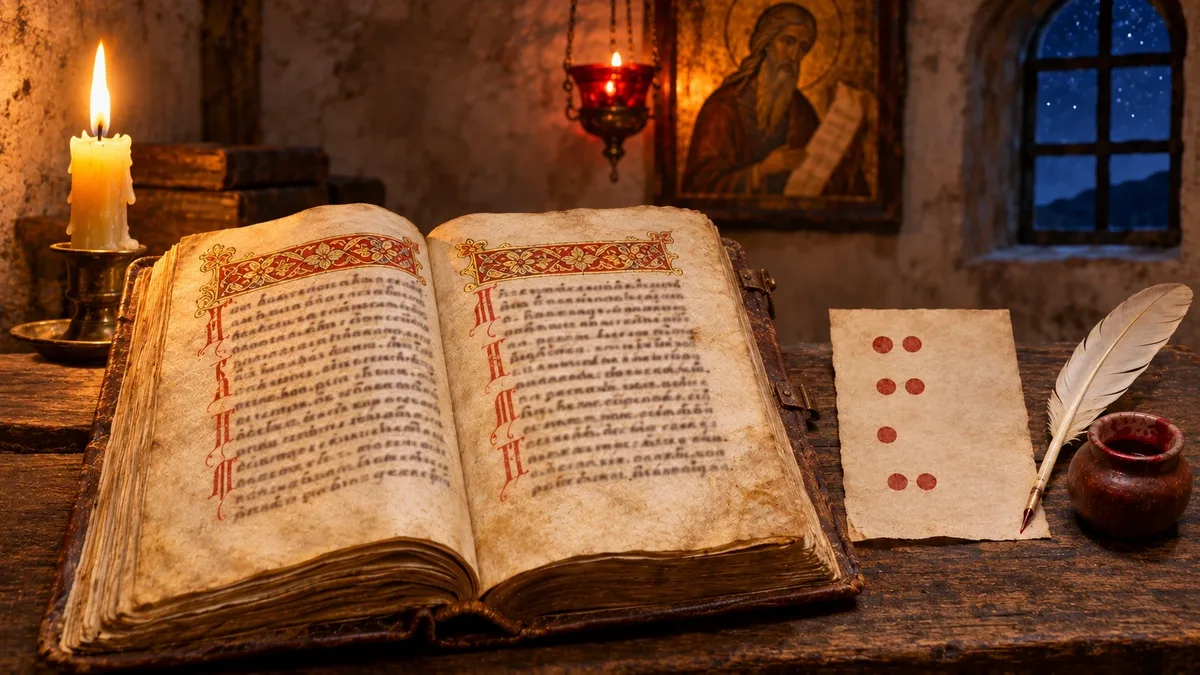
"An ancient and truthful good news: this art was revealed to the prophet Samuel by the angel of the Lord, in sixteen figures." So begins a short text copied in Byzantine Greek manuscripts and, from the 1400s, in Slavonic ones in Serbia and Russia. It tells you to fast, sing the Trisagion, pray, and think of your question. Then you open the Gospels or the Psalter at random and look at the left-hand page.
Take the first letter of each of the first four lines. Some letters are "odd" and make one dot; others are "even" and make two. Stack the four rows of dots and you have one of sixteen figures, each with a name, like the Way, Great Fortune or White Silver, and an answer. They are the same figures as the Arabic science of the sand, here hidden inside the letters of the holy book.
How to consult
- Think of your question silently. Type it in if you like; it stays on your device.
- Say the short prayer if you wish, then tap Open the Psalter. The book opens at random.
- The first letter of each of the first four lines on the left page is marked, and turned into one dot or two.
- The four rows make your figure. Read its old answer, translated from the Slavonic, and our short reading.
The odd and even letters
As the Slavonic text lists them. They are the letters that are also numbers, taken in turn: one for one, three for three, and so on.
The sixteen figures
Your question and answers stay on this device.
Your past figures
How do we know?
- ✔ A Byzantine text. The Greek original, called the "Prediction method by means of the Holy Gospel and the Psalter", survives in manuscripts of the 1400s to the 1700s. Some copies credit it to the emperor Leo the Wise, others to the prophet Samuel. Florin Filimon studied it in 2019 and showed that it is a short geomancy text, the science of the sand, turned into a way of reading the Bible.
- ✔ A Slavonic translation. It was put into Slavonic, probably in the 1400s. Mikhail Speransky printed it in 1899 from a Serbian manuscript of 1646, with readings from another in Vienna. Our English is translated from his printed pages.
- ✔ The figures. The text spells out every figure by its letters ("one even, one odd, one even, one odd"), so the dots are certain. Two figures have no name in the Slavonic copy; we give the names from the Greek copies, Prison and Tomb, and Shedding of Blood.
- ✔ A forbidden book. Church lists of banned books in Russia condemned fortune-telling by the Psalter and by geomancy, which the Russians called rafli. Scholars have linked this text with both.
- ≈ Our book. The old readers used a Church Slavonic Psalter or Gospel book. We open the Russian Synodal Psalter of 1876, which is free to use. Its modern letters mostly match the old lists (е counts as є, и as и). When a line begins with a letter the old lists do not include, such as б, к or о, we take the next letter in the line that they do include. That rule is ours.
- ≈ Lines and verses. The text means the printed lines of the page. Here each verse stands for a line.
- ✔ What the answers are about. The old answers speak of battles, enemies, sickness, kingdoms and childbirth, the worries of their time. We translate them as they are, and add a short modern reading of our own.
Text: М. Н. Сперанский, Из истории отреченных книг, I: Гадания по Псалтыри (St Petersburg, 1899), Texts, pp. 15–20, from the Šafařík manuscript of 1646 and Vienna Hofbibliothek no. 108 (public domain, Internet Archive). Study: F. Filimon, "The prediction method by means of the Holy Gospel and the Psalter: a late Byzantine case of a reassigned geomantic text", in P. Magdalino and A. Timotin (eds), Savoirs prédictifs et techniques divinatoires de l'Antiquité tardive à Byzance (2019), pp. 235–304 (facts only). Psalter: Russian Synodal translation (1876, public domain), from Wikisource. English: our own. Monastery picture: made for this app.
The text asks you first to sing the Trisagion with a contrite heart:Святый Боже, Святый Крепкий, Святый Безсмертный, помилуй нас.Holy God, Holy Mighty, Holy Immortal, have mercy on us.
The book is closed.
Your figure will appear here.
The figure will give the answer.