The Dice of Maheśvara 摩醯首羅卜
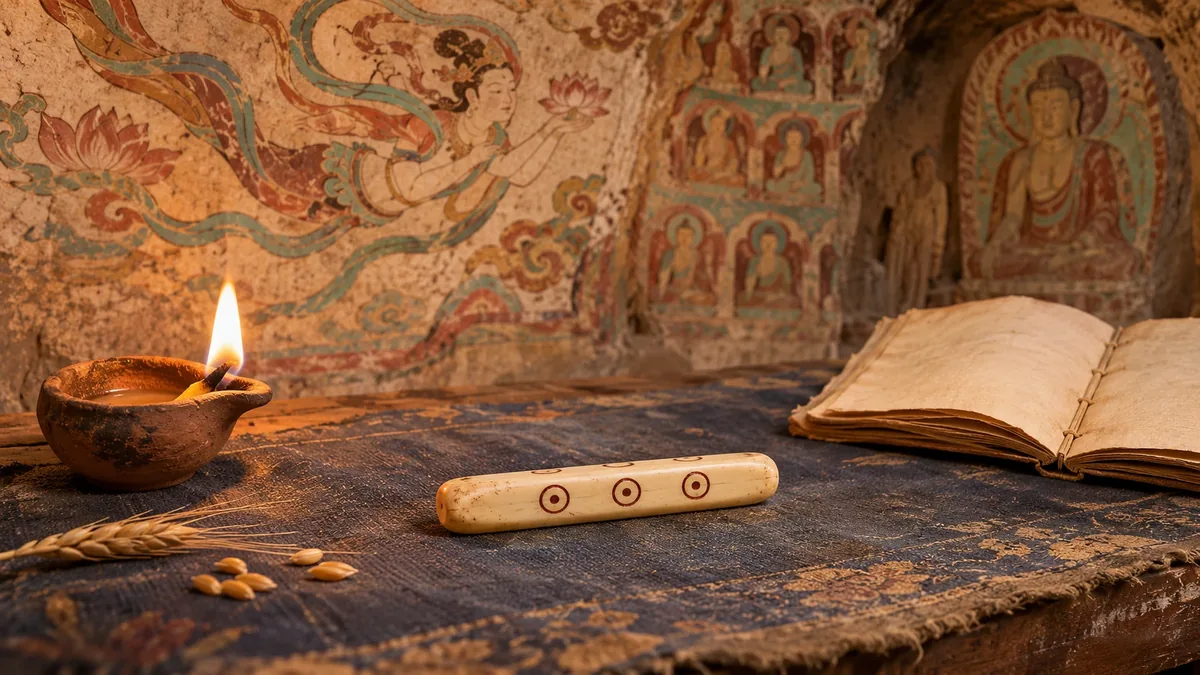
A thousand years ago, in the Buddhist caves of Dunhuang on the Silk Road, someone copied this little book of dice fortunes. You throw one four-sided die three times. The three numbers make a “set”, and every set belongs to a god or spirit: Brahmā and Guanyin, the Queen Mother of the West, the Thunder Lord, the Spirit Turtle, even a demon who burns the wheat. The god tells you what lies ahead, and the book gives its verdict, from greatly lucky to unlucky.
The book's own instructions
How to consult
- Imagine the gods gathered around you: Indra, Brahmā, the Four Heavenly Kings and all the spirits. The book says to sit facing west, towards the Buddha's paradise.
- Say your name, set your mind firmly on your question, and make a vow. Type the question in if you like; it stays on your device.
- Tap Throw the die: it is thrown three times to make one set.
- If the set is good, stop: one answer is enough. If it is bad or uncertain, the book lets you throw up to three sets.
Your question and answers stay on this device.
Your past answers
How do we know?
- ✔ The manuscript. The text is in a small booklet from the library cave at Dunhuang, now in the British Library (S.5614), copied in the 10th century. It was sealed in the cave about AD 1000 and found in 1900.
- ✔ Its gods. Maheśvara is the Buddhist name for the great Indian god Śiva. The gods of the sets come from India, from Buddhism and from Chinese religion, all mixed together, as they were on the Silk Road.
- ✔ The rules. The die has four faces, 1 to 4, and is thrown three times. If the answer is good you stop; if it is bad you may look at up to three sets. The book says believers may use it, but not those who don't believe.
- ≈ Gaps and doubles. The book has 65 entries, not 64: two throws (1-3-1 and 1-4-3) have two answers each, and one throw (1-3-2) has none. A few characters are lost (□). When your throw has two answers, the app shows both; when it has none, the gods are silent and you throw again.
- ≈ The die. The manuscript doesn't describe it. Long four-sided dice of bone were used in India and Central Asia, so the app shows one.
- ✔ Our words. The English translation and the modern readings are written for this app.
Chinese text: manuscript S.5614 (British Library), as read by B. Dotson, C. A. Cook and Zhao Lu, Dice and Gods on the Silk Road: Chinese Buddhist Dice Divination in Transcultural Context (Brill, 2021; open access, CC BY-NC 4.0). English translation and readings: our own.
Face west. Say your name, fix your mind on your question, and make your vow.
The gods are gathering.