The Sacred Oracle of Hermes

In the market square of Kibyra stood a stone pillar, and with it a statue of Hermes, the god of lots and lucky finds. You threw five knucklebones, added up the sides, and found your answer carved on the stone: 56 answers, each spoken by a god. Ask about a journey, a sale, an illness or a plan.
How to consult
- Think of one clear question: the stone speaks most often of journeys, buying and selling, illness, lawsuits and plans. Type it in if you like; it stays on your device.
- Tap Throw the five knucklebones. Each bone lands on one of its four sides, worth 1, 3, 4 or 6, and the app adds them up.
- The five sides you threw point to one of the 56 answers on the stone: first the god who answers, then a line describing your throw, then the god's words in verse.
- The badge tells you the answer in short: Go ahead, Wait or Do not. The verse is for you to think over.
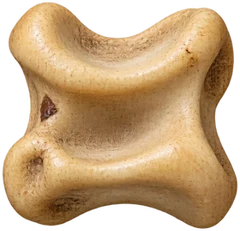 1χῖον
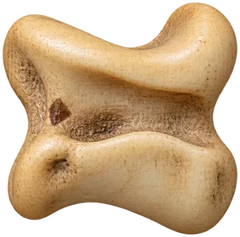 3ὕπτιον
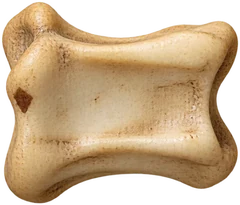 4πρανές
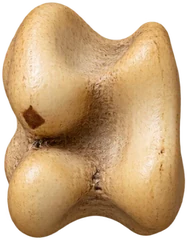 6κῷον
Your question and answers stay on this device.
Your past answers
How do we know?
- ✔ A real stone. The pillar was found in 2024 in the agora of Kibyra, in south-west Türkiye, built into the wall of a later chapel. It is carved on all four sides and dates from the 2nd or 3rd century AD.
- ✔ One of many. More than a dozen towns in the region set up the same oracle in their markets, with almost the same words. A rich citizen paid for the Kibyra one, with a statue of Hermes beside it.
- ✔ How it works. Each answer begins with the numbers thrown, their total and the god's name; then a line describing the throw; then the god's answer in verse. Five sixes, the best throw, belongs to Hermes himself.
- ✔ Apollo and Hermes. The oracle says its words come from Apollo of Delphi, but dice and lots were Hermes' gift, so Hermes "speaks" them from his pillar.
- ✔ Why Hermes? The stone's heading says that whoever paid for the oracle also set up "(the statue of) Hermes, along with a base". On the copies at Kremna, Termessos and Tyriaion the block has holes on top where a statue stood. The last answer, for the highest throw, belongs to Hermes the Four-Square, the god of such four-sided pillars, so the pillar was a "speaking Hermes". In the Homeric Hymn to Hermes, Apollo gives Hermes the bee-maidens of Parnassus, who tell the future, and Hermes became the patron of lots.
- ✔ Apollo at Kibyra. Apollo was one of the city's great gods. The Roman orator Cicero tells how two brothers of Kibyra, a wax-modeller and a painter, robbed a temple of Apollo there and fled to the corrupt governor Verres. Inscriptions from the agora honour Apollo's priests, such as Kallikles and Troilos. So the Kibyrans could hear the oracle as Apollo's own voice.
- ✔ Broken places. The tops and bottoms of the stone's faces are lost, so some answers are missing or only scraps survive. If you throw one, the stone is silent. Where another town's copy of the same oracle keeps the words, we give them and say where they come from: nine whole answers, and three more completed (words in ⟨ ⟩ come from the other copies). Only two throws stay silent here.
- ? How the bones fall. Real knucklebones land on their broad sides (3 and 4) far more often than their narrow ones (1 and 6). We use roughly that balance; the exact odds varied from bone to bone.
Greek text: the stone as read by Ş. Kileci, N. Tüner Önen, Ş. Özüdoğru, "A New Astragalos Oracle Text from Kibyra", Gephyra 31 (2026) 257–294 (open access, CC BY-NC-SA 4.0); restored letters are shown as plain text. English: our own translation. Throws 41 and 42: the Termessos copy, from F. Heinevetter, Würfel- und Buchstabenorakel in Griechenland und Kleinasien (1912), nos. XLI-XLII; throws 55 and 56: the Anabura copy, from J. R. S. Sterrett, The Wolfe Expedition to Asia Minor (1888) nos. 339-342 (both public domain); throws 10, 11, 26, 27, 40, and the missing parts of 28, 39 and 43: J. Nollé, Kleinasiatische Losorakel (Munich: C. H. Beck, 2007), pp. 136-167. Our reading and translation. Hermes: Kileci et al. 2026, pp. 261, 282-283, after Nollé 2007, p. 109; Homeric Hymn to Hermes 550-566. Apollo at Kibyra: Cicero, Against Verres II.4.30-31; Ş. Kileci, "Three Inscriptions from Cibyra", OANNES 6/2 (2024) 387-399. Knucklebones: photographed views. Sounds: Kenney (CC0).
The stone waits for your throw.