The Moon Blocks 擲筊
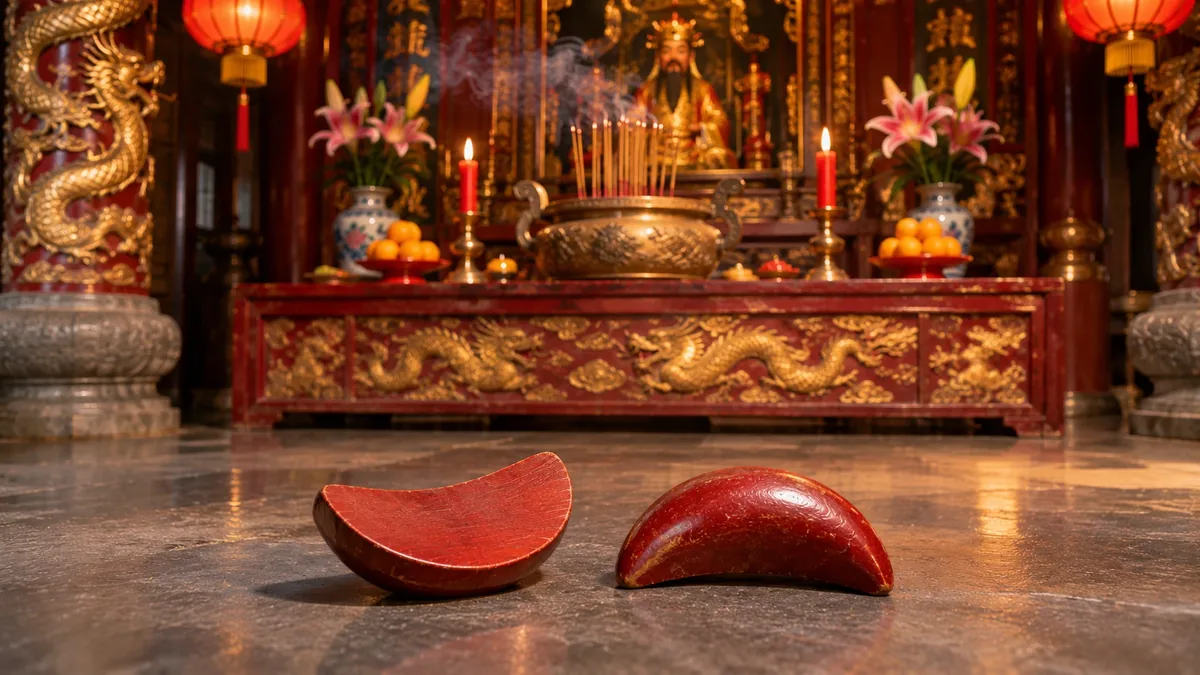
In Taoist and folk temples across Taiwan, southern China and Southeast Asia, people ask the gods yes-or-no questions with two red wooden blocks shaped like crescent moons. Each block has a flat face and a rounded face. You tell the god who you are and what you want to know, then drop the blocks on the floor before the altar, and the way they land is the god's reply. The custom is more than a thousand years old.
How to consult
- Choose the god you want to ask.
- Tell the god, silently, who you are: your name, your birthday and where you live. Then ask your question. Make it one that can be answered yes or no. Type it in if you like; it stays on your device.
- Choose one throw, or, for an important question, three in a row: then the god must give holy blocks three times running.
- Tap Throw the moon blocks and see how they land.
聖筊Holyone flat, one round · yes
笑筊Laughingboth flat · ask again
陰筊Yinboth round · no
Your question and answers stay on this device.
Your past answers
How do we know?
- ✔ An old custom. The Tang poet Han Yu, visiting the temple of the god of Mount Heng in the early 9th century, wrote that the old temple keeper handed him the blocks (杯珓) and showed him how to throw them, and told him his throw was the luckiest of all.
- ✔ A living one. Moon blocks are thrown every day in temples in Taiwan, Fujian, Guangdong, Hong Kong, Singapore and Malaysia, to Mazu, Guanyin, Lord Guan, the Earth God and many others. People also throw them to ask whether they may draw a fortune stick, and whether the stick they drew is the right one.
- ✔ The three answers. One flat and one round face is 聖筊 (holy blocks): yes. Two flat faces is 笑筊 (laughing blocks): the god laughs, so ask again more clearly. Two round faces is 陰筊 (yin blocks, also called covered or angry blocks): no.
- ≈ The names and customs vary. Different places use different names, and some read two flat faces differently. Asking for three holy blocks in a row for a big question is common, but not a fixed rule.
- ≈ The odds. Real blocks are not perfectly even, and how they fall depends on their shape and on the floor. The app makes each face equally likely, so holy blocks come up about half the time, and three in a row about one time in eight.
- ✔ Our words. The explanations of the answers are written for this app.
Han Yu 韓愈, 〈謁衡嶽廟遂宿嶽寺題門樓〉 (“Visiting the temple of Mount Heng”), early 9th century: public domain. Modern practice: temple custom in Taiwan and southern China.
Throws:
The moon blocks lie before the altar.
The god is listening.