The Guanyin Lots 觀音靈籤A hundred poems from the temples of Guanyin
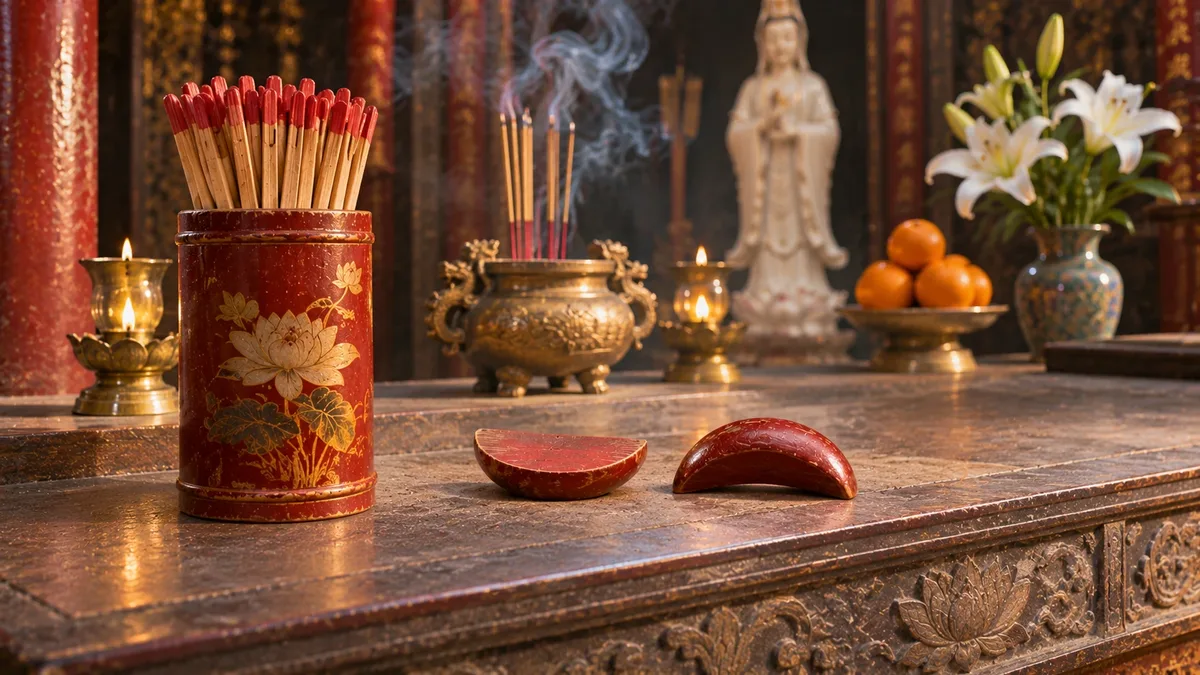
In temples of Guanyin, the Buddhist saint of mercy, people kneel with a bamboo cylinder full of numbered sticks and shake it gently, tilted forward, until one stick works its way out and falls to the floor. Then they drop two moon blocks to ask whether this is the right stick. If it is, the number gives them a paper slip with a short poem on it.
Each of the hundred poems is named after a story from Chinese history or legend. Each slip also carries a grade of luck, a short reading, and quick answers on fifteen everyday matters, from money and marriage to lost things and travellers. This is the set used in Hong Kong and across Southeast Asia, where it is called kau chim.
How to consult
- Think of your question. Type it in if you like; it stays on your device.
- Tap the cylinder (or Shake the sticks). It tilts and rattles until one stick falls out.
- Drop the moon blocks to ask Guanyin whether this is your stick. One flat face and one round face means yes. Anything else means put the stick back and shake again.
- Read your slip: the poem with our English, its story, its reading, and the answers for the matter you asked about.
The grades of luck
How many of the hundred lots have each grade.
Your question and answers stay on this device.
Your past slips
How do we know?
- ✔ A living custom. Shaking a cylinder of numbered sticks, called 求籤, is done every day in temples of Hong Kong, Guangdong, Taiwan, Singapore and Malaysia. Many temples keep a stall outside where an interpreter will read your slip for a small fee.
- ✔ Checking with the blocks. Before taking a stick, people drop the moon blocks to ask whether it is the right one, and shake again if the answer is not yes.
- ≈ How old it is. Temple lot poems were already in use in China by the Song dynasty, more than 800 years ago. When this particular set of a hundred was written is not known. It survives in lot books printed since then, and the versions differ from temple to temple.
- ✔ Two sets. Two different hundred-lot sets are both called Guanyin lots. The Taiwan set used at Lungshan Temple in Taipei begins with the Song emperor in the yellow robe. The Hong Kong set used here begins with Zhongli becoming an Immortal. They share many of the same poems, but in different words.
- ✔ Our text. We compared the poems in three copies: two of the Hong Kong set and one of the Taiwan set. Where the Hong Kong copies are plainly garbled, we took a word or a line from the Taiwan copy. In Lot 6, for example, "feed the tiger" is garbled into "a copper bird".
- ≈ The grades. Our copies disagree about the grade of fifteen lots, mostly whether a lot is middling or good, or middling or poor. For those we judged from the poem, and the slip says so.
- ≈ The stories. Each lot is named after a story, but the old lot books themselves note that some stories do not fit their poems. A few stories are lost, and a few lot books name a different one.
- ✔ Our words. The English translations, the stories as told here, and the one-line summaries are written for this app.
Chinese poems: the Hong Kong set as transcribed by Master Sean Chan (Vietnamese edition) and Handful of Leaves, checked against the Taiwan Guanyin hundred at temples.tw (台灣好廟網), which also gives the short readings (解曰), images (籤意) and tables of matters. These are traditional temple texts, in the public domain. Study: 許宸瑋, 《觀音百首靈籤》的文獻與價值研究 (2024). English: our own. Moon blocks: the pictures from the Moon Blocks page. Temple picture: made for this app. Sounds: made in the browser.
Guanyin is listening.